Author: Bart Hillewaert

Workshop 4: New insights for integrating floating solar in Belgian offshore wind farms

Workshop 4: New insights for integrating floating solar in Belgian offshore wind farms

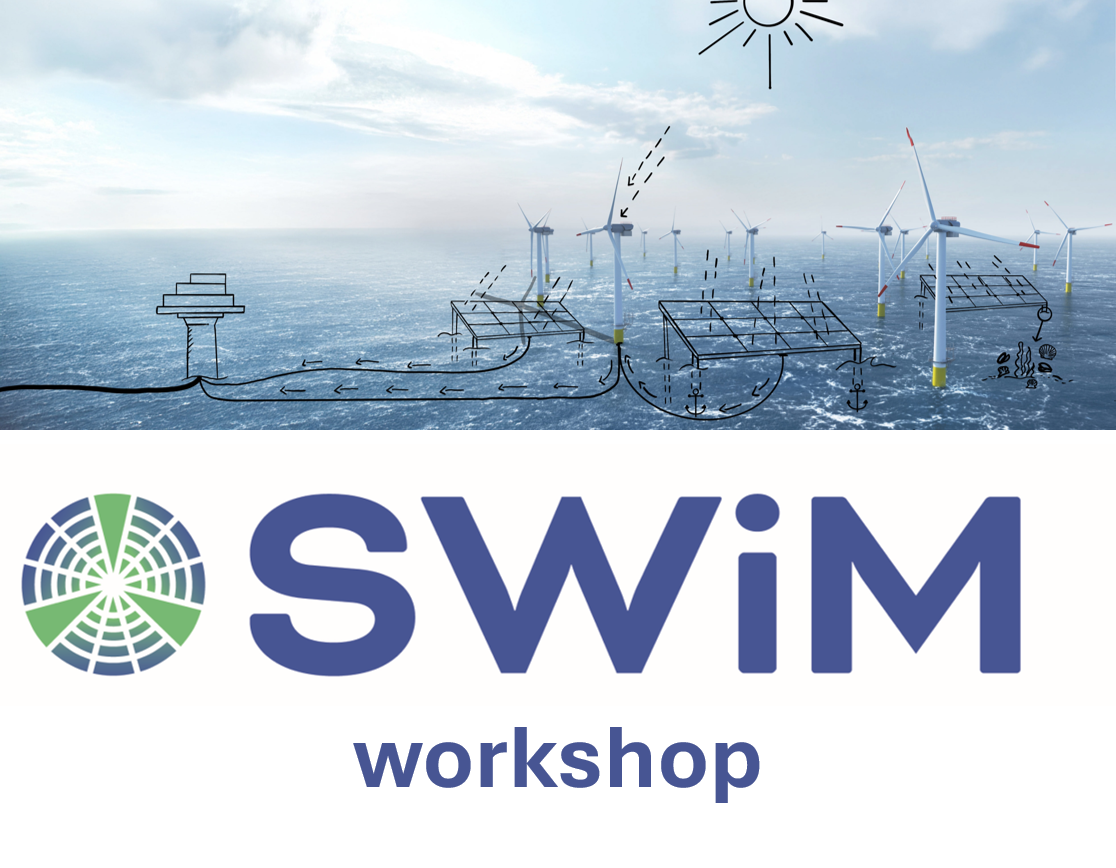
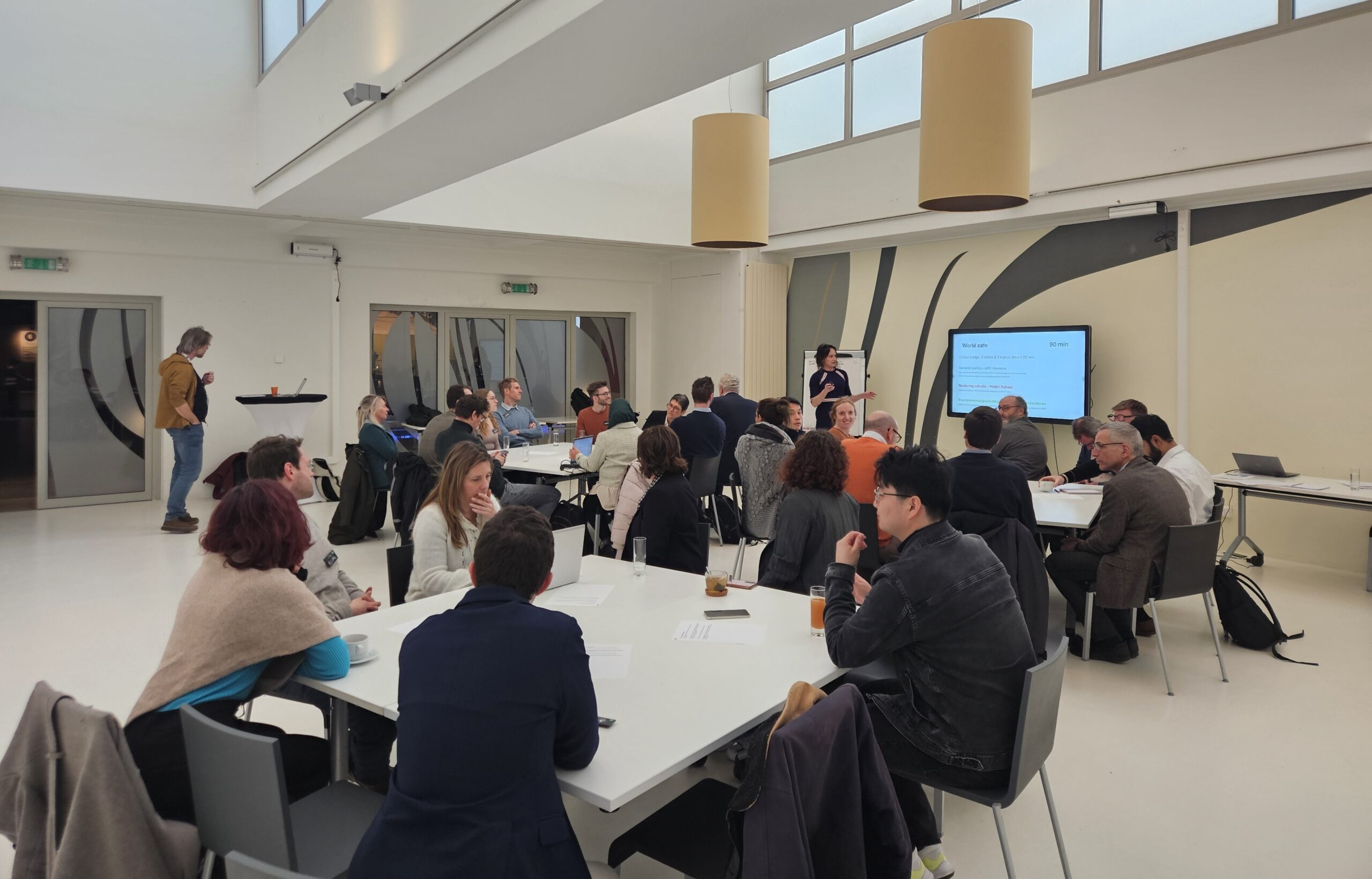
Join us on 8 September in Ghent for an interactive workshop exploring the future role of Offshore Floating Photovoltaics (OFPV) in the Belgian North Sea. Discover the latest insights from a new technical assessment of OFPV integration in offshore wind farms and help shape a shared vision for the future of offshore solar energy in Belgium.

This workshop is the fourth workshop within the scope of the SWiM project. It is an initiative by Blue Cluster with the support of all partners in the SWiM project.

Programme

Workshop 4 builds on the outcomes of the previous SWiM workshops and explores how Offshore Floating Photovoltaics can contribute to Belgium’s future offshore energy system, addressing questions such as:

  • What is the technical potential for integrating OFPV within existing and future Belgian offshore wind farms?
  • How can OFPV contribute to the development of multifunctional offshore systems and future Mariparks in the Belgian North Sea?

The workshop will present the results of a new technical assessment examining available electrical infrastructure, cable capacity, mooring opportunities, and the technically feasible OFPV capacity in Belgian offshore wind zones.

By bringing together experts from industry, research, policy and offshore energy, the workshop aims to develop a shared vision for OFPV in Belgium and explore how offshore solar energy can serve as a catalyst for broader multi-use developments at sea.

The workshop will conclude with an interactive discussion on the future role of OFPV in Belgium and its potential contribution to Maripark development in the Belgian North Sea.

Practical information

Date
8 September 2026

Timing
Welcome and lunch from 12:00
Workshop programme in the afternoon
Reception from 17:30 to 19:00

Venue
RodeBol Events
Sint-Denijslaan 485
9000 Ghent, Belgium

The main language of this event is English.

Participation is free of charge, but prior registration is required.

This event is invitation only. If you did not receive an invitation but are interested to attend, we kindly ask you to reach out to Kinnie De Beule or Marijn Rabaut.

Stay informed

Follow the latest developments of the SWiM project.

News

[arrow-right]

Events

[arrow-right]

Results

[arrow-right]

Continue reading

Results of the third workshop

Results of the third SWiM workshop

As offshore space becomes increasingly crowded, a key question emerges: how can we use the North Sea more efficiently while balancing energy production, food systems, ecosystem restoration, and maritime security?

These questions were at the heart of the third SWiM workshop, Towards a Future-Proof North Sea. Building on earlier discussions about offshore wind and floating solar, participants explored how offshore infrastructure can evolve from single-purpose energy sites into multifunctional platforms that create broader societal value.

The workshop took place on 3 March 2026 in Brussels and brought together stakeholders from industry, research and policy to discuss the future of multi-use offshore systems in the Belgian North Sea.

From single-use to multi-use

A recurring theme throughout the discussions was the shift from efficiency towards system robustness. While offshore wind remains the backbone of the energy transition, participants agreed that future offshore developments should be designed from the outset to accommodate multiple functions. Multi-use is no longer seen as simply sharing space, but as creating synergies between energy production, biodiversity enhancement, food production, and security services.

The workshop highlighted that low-risk, nature-based solutions currently offer the most realistic starting point for multi-use in offshore wind farms. Nature restoration measures such as artificial reefs and habitat enhancement can support biodiversity while complementing existing offshore infrastructure. Similarly, low-impact aquaculture systems may contribute to food production, provided they are integrated into wind farm design from an early stage.

Designing for the future

Participants also emphasized the growing importance of protecting critical maritime infrastructure. Offshore energy assets can play a wider role in maritime surveillance and situational awareness through integrated monitoring technologies, contributing to a safer and more resilient North Sea.

Across all discussions, one message stood out clearly: successful multi-use requires co-design rather than retrofitting. Energy, nature, food production and security should be considered together from the planning phase onwards. Achieving this vision will require collaboration across sectors, supportive regulatory frameworks and continued experimentation through pilot projects.

Conclusions

Today, participants broadly agree that the future of the Belgian North Sea lies in gradually moving from single-use energy infrastructure towards integrated multi-use systems. Starting with low-risk pilot projects while developing a long-term vision for multifunctional offshore spaces appears to be the most promising pathway towards a more resilient, sustainable, and future-proof North Sea.
BIG THANKS to all speakers, experts and participants who contributed to the discussions and shared their insights throughout the workshop.

Full report

Curious to dive deeper into the workshop’s insights? A comprehensive report of the workshop is now available.

Continue reading

Integrating Floating Solar into OW Farms: Smart Planning in SWiM

Integrating Floating Solar into Offshore Wind Farms: Smart Planning in SWiM

Floating solar panels at sea are an exciting opportunity, but they only make sense if the electricity they generate can reliably reach homes and industries onshore. Connecting offshore solar to the grid is therefore a crucial step. At the moment, offshore wind farms offer the most practical solution.

Wind farms are already connected to the onshore grid through powerful export cables. They are also designated zones where fishing and commercial shipping are restricted. Installing floating solar systems between wind turbines therefore avoids spatial conflicts while making use of existing infrastructure.

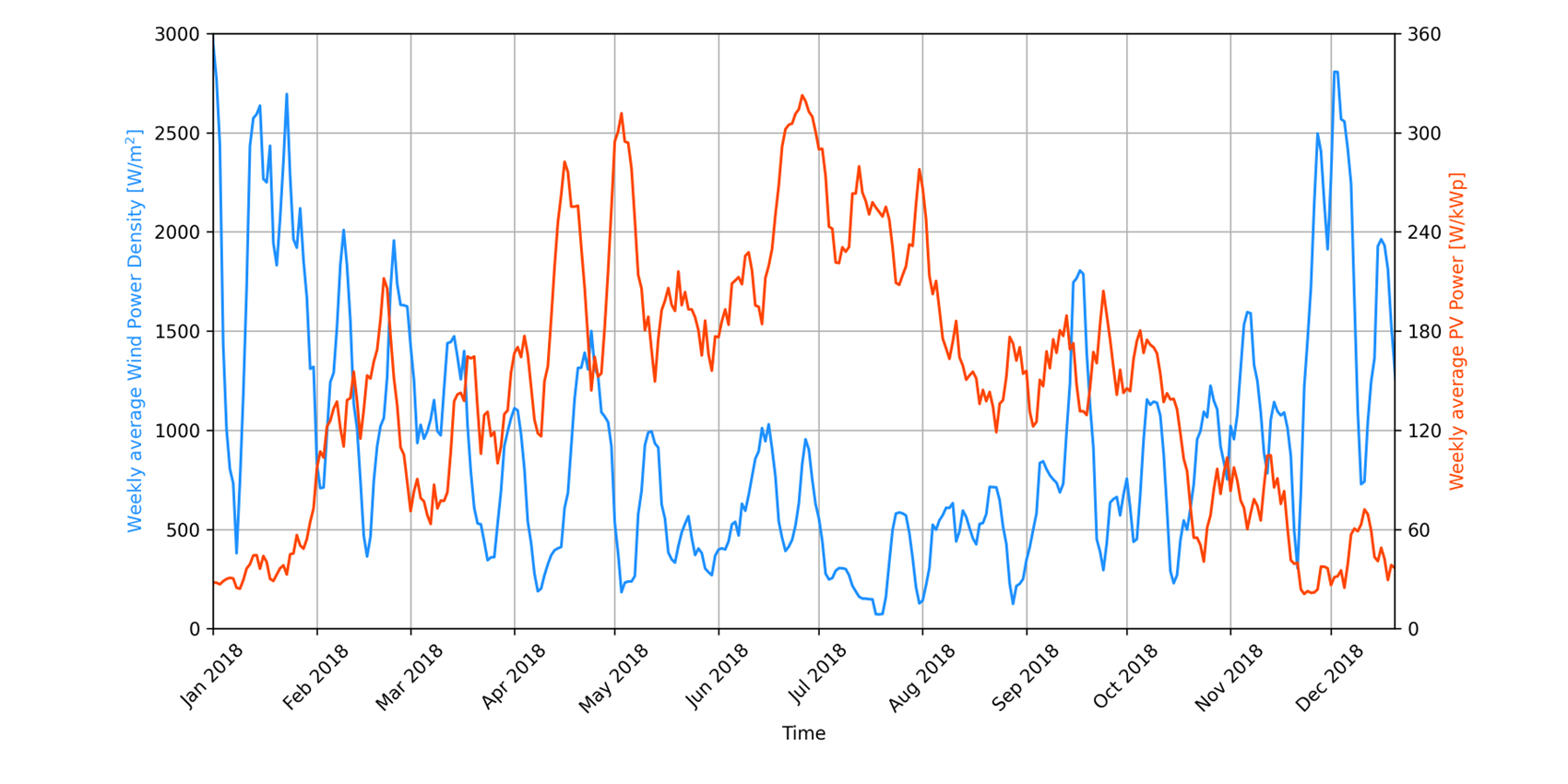
There is another advantage: wind and solar complement each other seasonally. Offshore wind produces most electricity during winter, while solar power production peaks in summer. Sharing the same grid connection allows both technologies to use the cables more efficiently throughout the year. Research in the Belgian North Sea has demonstrated this strong complementarity between offshore wind and floating photovoltaics (Delbeke et al., 2023).

Finding the Best Connection Points

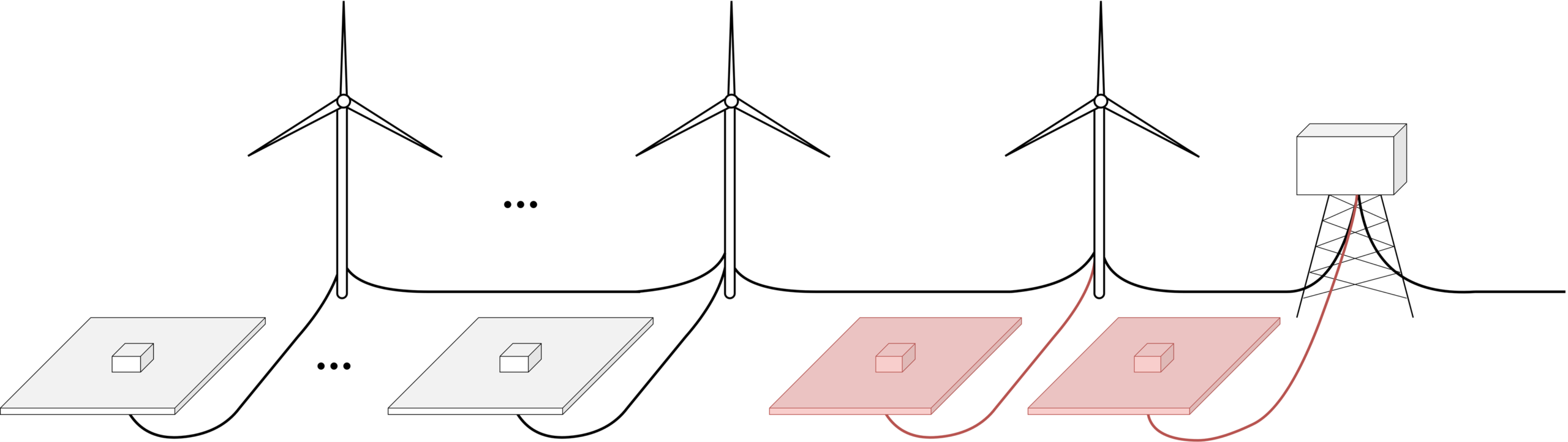
Within the SWiM project, researchers go one step further. Beyond sharing export cables, the project investigates where exactly floating solar systems should be connected inside a wind farm.

To answer this question, the team uses optimal power flow simulations. These simulations model how electricity moves through the internal cable network that connects the wind turbines to the offshore substation. They show where spare electrical capacity is available and where additional power could cause congestion or overload.

Different connection options for floating solar systems are tested in the model. The objective is clear:

  • Integrate as much additional solar power as possible
  • Avoid hindering the electricity produced by existing wind turbines
  • Prevent cable overloading
  • Minimise transmission losses

Complementarity of offshore wind and floating photovoltaics in the Belgian North Sea. Delbeke et al., 2023 . 

What Did We Learn?

The simulations show that floating solar systems are best connected:

  • Directly to the offshore substation; or
  • To wind turbines located closest to the substation

At these locations, the network can support the highest additional power transfer. At the same time, transmission losses remain limited.

These insights are an important step toward efficient hybrid offshore energy systems. By carefully planning grid integration, floating solar can be added to existing wind farms without major additional infrastructure.

Smart generation expansion planning ensures that offshore space and grid capacity are used efficiently, helping Europe move toward a more flexible, resilient and integrated renewable energy system. 


Stay informed

Follow the latest developments of the SWiM project.

News

[arrow-right]

Events

[arrow-right]

Results

[arrow-right]

Continue reading

SWiM-related research presented at ICES

SWiM-related research presented at ICES

In September 2025, research acknowledged within SWiM was presented at the ICES Annual Science Conference (ASC). The contribution focused on modelling the potential biogeochemical impacts of floating photovoltaic (FPV) systems co-located with offshore wind farms in the Belgian North Sea, supporting SWiM’s ambition to strengthen the scientific basis for integrated offshore energy development.

From 15 to 18 September 2025, the ICES Annual Science Conference(ASC) took place in Klaipėda, Lithuania, bringing together nearly 600 marine scientists from around the world. The conference serves as a key international platform for presenting innovative marine research, exchanging ideas and fostering long-term scientific collaboration.

Pauline Denis, Arthur Capet and Jan Vanaverbeke attended the conference and participated in sessions and workshops relevant to offshore renewable energy and environmental impact assessment. 

Within this context, Pauline Denis presented a scientific poster entitled: Biogeochemical impacts of basin-scale floating solar infrastructure deployment within an offshore wind farm in the Belgian North Sea.”

The poster presented modelling work using a 1D approach to assess potential biogeochemical impacts of floating solar panels integrated within an offshore wind farm.

Although the study was initiated under the EcoMPV ETF project, it aligns closely with SWiM’s objectives, notably by contributing to:

  • improved understanding of cumulative environmental effects of multi-use offshore energy systems;

  • integrated assessments of offshore wind and floating solar co-location; and

  • evidence-based support for marine spatial planning.

  • ICES 2025-1

  • ICES 2025-3

  • ICES 2025-4

Relevance for SWiM

The conference presentation illustrates how SWiM-acknowledged research contributes to improving scientific understanding of the environmental impacts of multi-use offshore renewable energy systems.

Stay informed

Follow the latest developments of the SWiM project.

News

[arrow-right]

Events

[arrow-right]

Results

[arrow-right]

Continue reading

Workshop 3 – From offshore energy infrastructure to multi-use

Workshop 3 – From offshore energy infrastructure to efficient and secure multi-use

Join us on 3 March in Brussels for an interactive workshop exploring how offshore wind farms can evolve into multifunctional platforms. Dive into topics such as nature restoration, food production, smart infrastructure and offshore security, and help shape integrated solutions for a resilient North Sea.

This workshop is the third workshop within the scope of the SWiM project. It is an initiative by Blue Cluster with the support of all partners in the SWiM project. 

Programme

Workshop 3 broadens the scope beyond energy and explores offshore wind farms as multi-use platforms, addressing questions such as:

  • How can food production, nature restoration and sea ranching fit within wind farms and other offshore energy devices?
  • What is the role of smart structures, smart ports and offshore security?

 By bringing together experts from energy, maritime activities, policy, security and research, the workshop aims to identify concrete pathways toward efficient and secure multi-use offshore systems.

The detailed programme is not yet available. More information will follow shortly.

Practical information

The main language of this event is English.

Participation is free of charge, but prior registration is required.

It is no yet possible to register for the event. More information will follow shortly.

This event is invitation only.

If you did not receive an invitation but are interested to attend, we kindly ask you to reach out to Kinnie De Beule or Marijn Rabaut.

Stay informed

Follow the latest developments of the SWiM project.

News

[arrow-right]

Events

[arrow-right]

Results

[arrow-right]

Continue reading

New insights into offshore FPV performance and design

New insights into offshore FPV performance and design

Recent analyses provide a clearer view of how floating PV behaves in harsh marine conditions and which design choices offer the best balance between durability, efficiency, and compatibility with offshore wind. The findings highlight both the technical feasibility and the key challenges that must be addressed for reliable large-scale deployment.

Work Package 1 Update

The SWiM Deliverable D1.1, issued by imec and UHasselt, reviews the operating conditions and design concepts for floating photovoltaic (FPV) systems, with a focus on offshore applications. The report includes energy yield simulations for case studies in the North Sea, including the SeaVolt pilot in Ostende.

Offshore FPV faces harsher conditions than inland systems, including stronger winds, higher UV exposure, humidity, salinity, and biofouling, which demand robust, marine-grade materials and structural designs. Despite these challenges, offshore locations provide cooling benefits due to lower ambient and module temperatures, slightly improving PV efficiency.

Among design concepts, east-west orientation – although yielding 3–6% less annual energy than south-facing – offers advantages such as better space use, reduced wind loads, and alignment with demand peaks, making it promising for offshore deployment.

Platform elevation improves cooling modestly, and static shading simulations show that nearby wind turbine towers reduce annual PV yield by less than 3% in the worst-case scenario (tower south), reinforcing the viability of hybrid offshore wind–PV farms.

Overall, the report concludes that offshore FPV is technically feasible and complementary to offshore wind, provided durability and reliability challenges in marine environments are addressed. Further assessment of reliability aspects, including Failure Mechanisms and Effects Analysis, and mechanical stress evaluation, is in progress.

Fig 1. Daily variation of module temperature (daily mean) averaged over five years (2020-2024) in the North Sea (offshore) and Genk (inland) for an east-west facing system with 15° tilt.

Fig 2. Daily variation of UV dose averaged over five years (2020-2024) in the North Sea (offshore) and Genk (inland) for an east-west facing system with 15° tilt.

Fig 3. Simulated Specific Yield averaged over five years (2020-2024) in the North Sea (offshore) and Genk (inland) for an east-west facing system with 15° tilt.

Stay informed

Follow the latest developments of the SWiM project.

News

[arrow-right]

Events

[arrow-right]

Results

[arrow-right]

Continue reading

Results of the second SWiM workshop

Results of the second SWiM workshop

We stand at a crossroads: should we focus on scaling mature technologies such as offshore wind to maximise efficiency and cost-effectiveness, or should we invest in diversification – integrating OPV, wave energy, and other emerging technologies – to strengthen system robustness, innovation and energy autonomy? These questions where at the heart of the second SWIM workshop.

When does system robustness outweigh price considerations? How do we balance innovation, resilience, and affordability in an increasingly complex offshore environment?

While many of the issues surrounding OPV- such as harsh marine conditions, grid integration, and environmental permitting- are of a practical and engineering nature, they also reflect broader choices about what kind of energy system we wish to build.

Should our offshore domain become a space of technological specialisation or a dynamic platform for multi-energy interaction?

The answers determine how Belgium’s offshore strategy contributes not only to renewable targets but also to long-term sustainability and sovereignty. The discussions showed that offshore wind currently faces economic challenges, making the integration of offshore floating solar (OFPV) systems complex and costly, so early development should occur nearshore or in sunnier regions while Belgium focuses on optimising wind energy and expanding storage capacity.

Effective combination of OFPV and wind requires co-design from the outset, since retrofitting existing infrastructure adds expense and undermines reliability. Although hybrid systems raise capital costs, they can become viable at scale, with energy storage offering more immediate benefits in the Belgian North Sea context.


Progress in OFPV depends on achieving design standardisation and advancing through small, low-risk pilot projects that pave the way for larger future deployments. Simplifying the current multi-agency permitting system into a single coordinated framework would greatly improve governance and project efficiency.

Policy support should focus on targeted innovation funding and accessible offshore testing, such as at the Blue Accelerator, rather than on modifying tenders unsuited to emerging technologies. Ensuring reliability requires corrosion-resistant materials, water-proof cabling, and durable PV module designs capable of withstanding harsh marine conditions.

While shading from turbines can cause modest solar energy losses, these effects can be minimised through optimised panel orientation and layout.

Given the limited feasibility of wave energy in Belgium, the most promising hybrid approach combines offshore wind, solar, and energy storage.

Conclusion

Today the opinion of the participants tends to be that Belgium should continue prioritising wind optimisation and storage integration while developing OFPV gradually through co-designed, standardised, and scalable systems.

BIG THANKS to our expert speakers Valentin Dupont(Ocean Energy Europe), Sten Swanenberg ( Dutch Wave power), Midas Caubergs (Elia) , Andrew Borg (FLASC).

Full report

Curious to dive deeper into the workshop’s insights? A comprehensive report of the workshop is now available.

Stay informed

Follow the latest developments of the SWiM project.

News

[arrow-right]

Events

[arrow-right]

Results

[arrow-right]

Continue reading

Explore the Future of Offshore Energy at the second SWiM Workshop

Explore the Future of Offshore Energy at the second SWiM Workshop

On 20 October, Blue Cluster and its partners in the SWiM project are hosting a dynamic workshop dedicated to exploring the frontiers of energy integration in offshore wind farms. This second event in the SWiM series will bring together experts and stakeholders to dive into promising technologies such as offshore photovoltaics, wave and tidal energy, and innovative storage solutions.

The afternoon will kick off with lunch and an introductory session highlighting current developments and key hurdles in the field. Participants will then engage in an interactive session designed to encourage collaboration and idea-sharing around the practical integration of these emerging technologies.

Programme

12:00  Welcome and lunch

13:00  Introductory presentation

  • Remaining challenges for OPV in wind
  • Wave energy potential
  • Storage potential
  • + tbd

14:00  Interactive session

16:00  Wrap-up and drinks

17:00  End of the event

Practical information

The main language of this event is English.

Participation is free of charge, but prior registration is required.

This event is invitation only.

If you did not receive an invitation but are interested to attend, we kindly ask you to reach out to Kinnie De Beule or Marijn Rabaut.

Register for the workshop

Stay informed

Follow the latest developments of the SWiM project.

News

[arrow-right]

Events

[arrow-right]

Results

[arrow-right]

Continue reading

Workshop 2 – Innovative energy integration in offshore wind farms

Workshop 2 – Innovative energy integration in offshore wind farms

Join us on 20 October for an interactive afternoon exploring innovative energy integration in wind farms — from offshore photovoltaics to wave, tidal, and storage solutions. Discover the latest insights, tackle the remaining challenges, and help shape the future of offshore energy systems.

This workshop is the second workshop within the scope of the SWiM project. It is an initiative by Blue Cluster with the support of all partners in the SWiM project.

Programme

12:00  Welcome and lunch

13:00  Introductory presentation

  • Remaining challenges for OPV in wind
  • Wave energy potential
  • Storage potential
  • + tbd

14:00  Interactive session

16:00  Wrap-up and drinks

17:00  End of the event

Practical information

The main language of this event is English.

Participation is free of charge, but prior registration is required.

This event is invitation only.

If you did not receive an invitation but are interested to attend, we kindly ask you to reach out to Kinnie De Beule or Marijn Rabaut.

Register for the workshop

Continue reading