Integrating Floating Solar into OW Farms: Smart Planning in SWiM

Integrating Floating Solar into Offshore Wind Farms: Smart Planning in SWiM

Floating solar panels at sea are an exciting opportunity, but they only make sense if the electricity they generate can reliably reach homes and industries onshore. Connecting offshore solar to the grid is therefore a crucial step. At the moment, offshore wind farms offer the most practical solution.

Wind farms are already connected to the onshore grid through powerful export cables. They are also designated zones where fishing and commercial shipping are restricted. Installing floating solar systems between wind turbines therefore avoids spatial conflicts while making use of existing infrastructure.

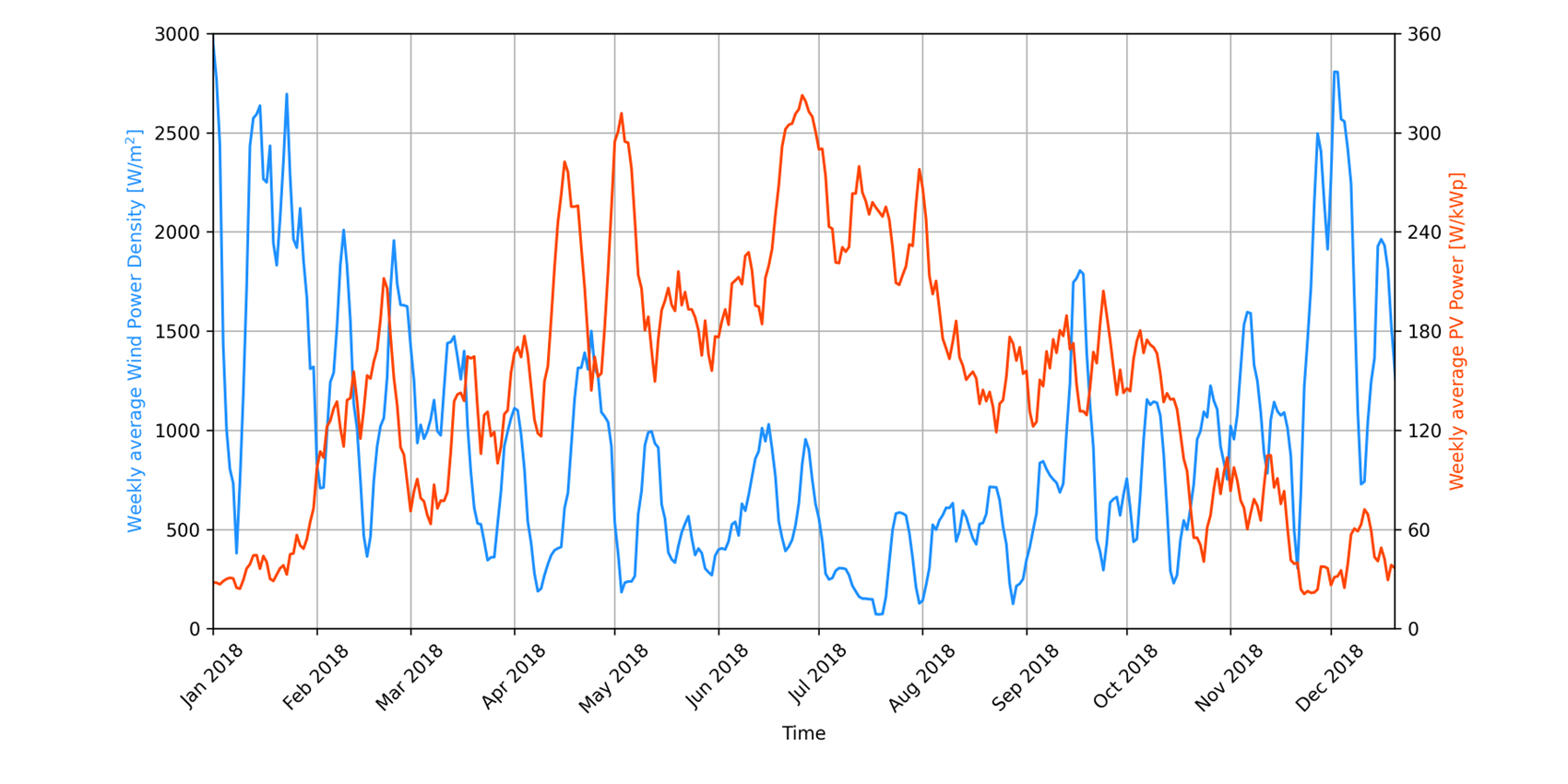
There is another advantage: wind and solar complement each other seasonally. Offshore wind produces most electricity during winter, while solar power production peaks in summer. Sharing the same grid connection allows both technologies to use the cables more efficiently throughout the year. Research in the Belgian North Sea has demonstrated this strong complementarity between offshore wind and floating photovoltaics (Delbeke et al., 2023).

Finding the Best Connection Points

Within the SWiM project, researchers go one step further. Beyond sharing export cables, the project investigates where exactly floating solar systems should be connected inside a wind farm.

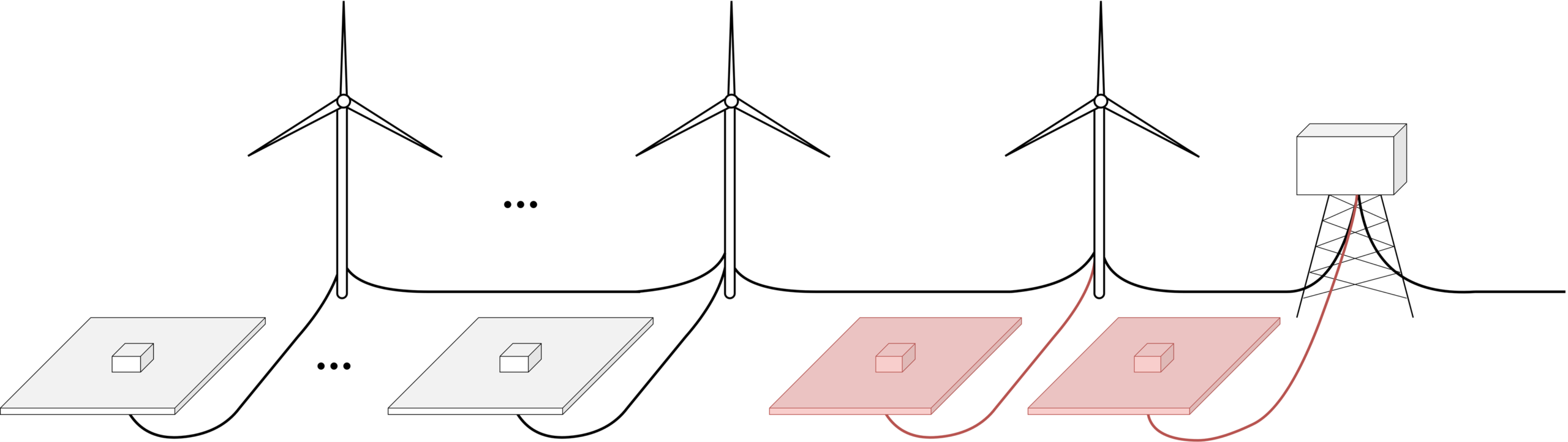
To answer this question, the team uses optimal power flow simulations. These simulations model how electricity moves through the internal cable network that connects the wind turbines to the offshore substation. They show where spare electrical capacity is available and where additional power could cause congestion or overload.

Different connection options for floating solar systems are tested in the model. The objective is clear:

  • Integrate as much additional solar power as possible
  • Avoid hindering the electricity produced by existing wind turbines
  • Prevent cable overloading
  • Minimise transmission losses

Complementarity of offshore wind and floating photovoltaics in the Belgian North Sea. Delbeke et al., 2023 . 

What Did We Learn?

The simulations show that floating solar systems are best connected:

  • Directly to the offshore substation; or
  • To wind turbines located closest to the substation

At these locations, the network can support the highest additional power transfer. At the same time, transmission losses remain limited.

These insights are an important step toward efficient hybrid offshore energy systems. By carefully planning grid integration, floating solar can be added to existing wind farms without major additional infrastructure.

Smart generation expansion planning ensures that offshore space and grid capacity are used efficiently, helping Europe move toward a more flexible, resilient and integrated renewable energy system. 


Stay informed

Follow the latest developments of the SWiM project.

News

[arrow-right]

Events

[arrow-right]

Results

[arrow-right]

Continue reading

SWiM-acknowledged research published on hydrodynamic impacts of floating solar

SWiM-acknowledged research published on hydrodynamic impacts of floating solar

In October 2025, research acknowledged within SWiM resulted in a peer-reviewed scientific publication investigating the hydrodynamic impacts of floating photovoltaic (FPV) systems co-located with offshore wind farms in the Belgian North Sea. The study contributes new quantitative insights that support SWiM’s ambition to strengthen the scientific basis for integrated offshore renewable energy development.

New scientific publication on hydrodynamic impacts of FPV systems

In early October 2025, a scientific paper entitled “Hydrodynamic alterations induced by floating solar structures co-located with an offshore wind farm” was published in the peer-reviewed journal Frontiers in Marine Science.

The study presents a three-dimensional (3D) modelling approach to quantify hydrodynamic changes associated with the deployment of floating solar panels within an offshore wind farm in the Belgian North Sea. The analysis focuses on key physical variables, including:

  • current speed;
  • bottom shear stress;
  • and turbulent kinetic energy.

The results provide first quantitative insights into how floating solar infrastructure may alter local and regional hydrodynamic conditions when integrated with offshore wind farms.

Although the research was initiated within the framework of the EcoMPV ETF project, SWiM is explicitly acknowledged in the publication as a relevant framework contributing to the broader scientific and policy context of the work.

Read the full paper in Frontiers in Marine Science.

Relevance for SWiM

This scientific publication demonstrates how SWiM-acknowledged research contributes to advancing understanding of the hydrodynamic impacts of multi-use offshore renewable energy systems, supporting integrated assessments of offshore wind and floating solar co-location.

Stay informed

Follow the latest developments of the SWiM project.

News

[arrow-right]

Events

[arrow-right]

Results

[arrow-right]

Continue reading

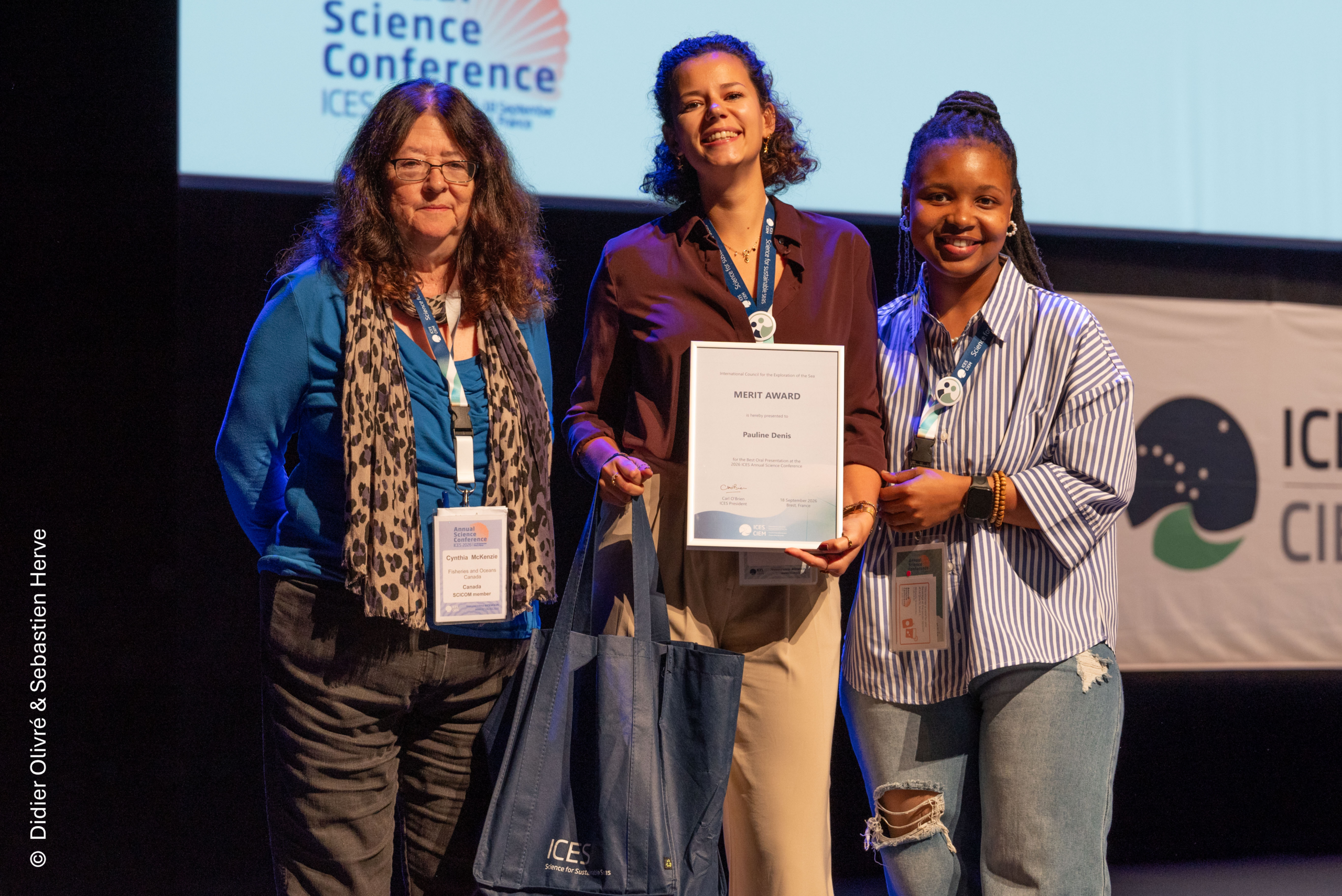
SWiM-related research presented at ICES

SWiM-related research presented at ICES

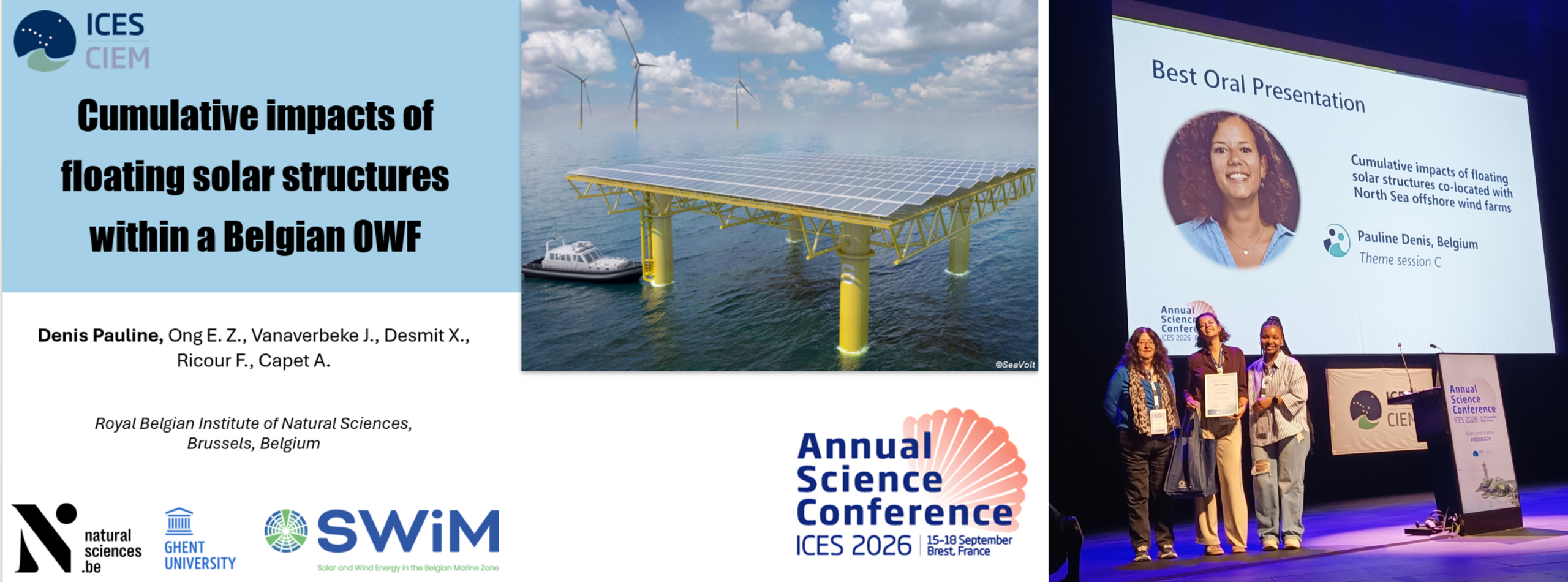
In September 2025, research acknowledged within SWiM was presented at the ICES Annual Science Conference (ASC). The contribution focused on modelling the potential biogeochemical impacts of floating photovoltaic (FPV) systems co-located with offshore wind farms in the Belgian North Sea, supporting SWiM’s ambition to strengthen the scientific basis for integrated offshore energy development.

From 15 to 18 September 2025, the ICES Annual Science Conference(ASC) took place in Klaipėda, Lithuania, bringing together nearly 600 marine scientists from around the world. The conference serves as a key international platform for presenting innovative marine research, exchanging ideas and fostering long-term scientific collaboration.

Pauline Denis, Arthur Capet and Jan Vanaverbeke attended the conference and participated in sessions and workshops relevant to offshore renewable energy and environmental impact assessment. 

Within this context, Pauline Denis presented a scientific poster entitled: Biogeochemical impacts of basin-scale floating solar infrastructure deployment within an offshore wind farm in the Belgian North Sea.”

The poster presented modelling work using a 1D approach to assess potential biogeochemical impacts of floating solar panels integrated within an offshore wind farm.

Although the study was initiated under the EcoMPV ETF project, it aligns closely with SWiM’s objectives, notably by contributing to:

  • improved understanding of cumulative environmental effects of multi-use offshore energy systems;

  • integrated assessments of offshore wind and floating solar co-location; and

  • evidence-based support for marine spatial planning.

  • ICES 2025-1

  • ICES 2025-3

  • ICES 2025-4

Relevance for SWiM

The conference presentation illustrates how SWiM-acknowledged research contributes to improving scientific understanding of the environmental impacts of multi-use offshore renewable energy systems.

Stay informed

Follow the latest developments of the SWiM project.

News

[arrow-right]

Events

[arrow-right]

Results

[arrow-right]

Continue reading

Explore the Future of Offshore Energy at the second SWiM Workshop

Explore the Future of Offshore Energy at the second SWiM Workshop

On 20 October, Blue Cluster and its partners in the SWiM project are hosting a dynamic workshop dedicated to exploring the frontiers of energy integration in offshore wind farms. This second event in the SWiM series will bring together experts and stakeholders to dive into promising technologies such as offshore photovoltaics, wave and tidal energy, and innovative storage solutions.

The afternoon will kick off with lunch and an introductory session highlighting current developments and key hurdles in the field. Participants will then engage in an interactive session designed to encourage collaboration and idea-sharing around the practical integration of these emerging technologies.

Programme

12:00  Welcome and lunch

13:00  Introductory presentation

  • Remaining challenges for OPV in wind
  • Wave energy potential
  • Storage potential
  • + tbd

14:00  Interactive session

16:00  Wrap-up and drinks

17:00  End of the event

Practical information

The main language of this event is English.

Participation is free of charge, but prior registration is required.

This event is invitation only.

If you did not receive an invitation but are interested to attend, we kindly ask you to reach out to Kinnie De Beule or Marijn Rabaut.

Register for the workshop

Stay informed

Follow the latest developments of the SWiM project.

News

[arrow-right]

Events

[arrow-right]

Results

[arrow-right]

Continue reading

New project combines wind and solar energy in Belgian North Sea

New project combines wind and solar energy in Belgian North Sea

In the SWiM project, six partners join forces to conduct research into the combination of marine technologies in the Belgian North Sea. The focus is on an ecologically sustainable integration of floating solar panels in wind farms.

The technology for floating photovoltaics has made great progress in recent years. Systems for lakes and reservoirs are being rolled out at gigawatt scale worldwide. Several approaches have been developed for offshore use, and a first number of demonstrators are being installed for this innovative technology. 

Owing to the harsh environment with its strong waves, wind, and risks of corrosion and fouling, this requires an entirely new structural development. Covering an area of less than 10% of a wind farm, PV systems with a nominal power approximately matching that of the wind turbines can be connected sharing the same grid connection, which helps reduce costs. 

The exact limits and curtailment losses have to be worked out by detailed analysis. A major beneficial factor is the complementarity of electricity generation between wind and solar throughout the year, as both energy sources are most productive at different times of the day and the year. There is a lot of wind in autumn and winter, and a lot of sun in spring and summer.

Concept

The SWiM project, which stands for Solar and Wind in the Belgian Marine Zone, is funded by the Belgian Energy Transition Fund of the Federal Public Service of the Economy and strives to draw up technical guidelines and policy recommendations towards multi-use of commercial zones at sea in so-called Mariparks.

In this concept, different technologies will be combined taking into account the possible effects of these parks on the marine environment, with effective and efficient integration of electricity generation by offshore wind and photovoltaics playing a key role. 

The results will be disseminated broadly to serve as a basis for decisions of commercial players and authorities alike.

Approach

  • The strengths and weaknesses of existing structures will be analysed, and options for their placement within wind farms and ecological effects will be mapped out.  The rules for deployment within wind farms need to be refined to consider different requirements and the interests of all users. Stakeholders will be consulted to work out rules that are safe and effective.
  • The electrical performance of the PV sysem will be modelled in detail based on an existing framework for simulating energy yields. Specific measures will be identified to ensure reliability of components in harsh offshore conditions.  
  • The detailed limits are determined by the thermal load of cables, and corresponding models will be refined to ensure best scaling while maintaining safe operating conditions.
  • Apart from the dimensions, the anchoring and mooring design determines to a large extent how the space at sea can best be used. This is complemented by requirements for safety distances and dedicated spaces for other uses. . In addition, biological effects need to be taken into account.  
  • A distinct goal of the project is to draw up policy advice and have an impact on marine spatial planning and permission rules. A series of workshops will therefore be held where stakeholders from all relevant areas can provide input. The project thus aims to develop guidelines that allow effective and safe co-use of the marine area designated for commercial purposes.

Johan Driesen, Professor of Electrical Engineering at KU Leuven affiliated with EnergyVille

“With the complementary expertise of the partners, we will determine the boundary conditions for the integration of solar and wind energy offshore. We will engage with stakeholders to work out pathways for effective deployment of this exciting combination of technologies. This can help to put Belgium firmly on the map when it comes to innovative renewable energy generation.”


Johan Driesen, Professor of Electrical Engineering at KU Leuven affiliated with EnergyVille

Partners

The project brings together six research, policy and industry partners:

  • Laborelec has broad expertise in renewables and electrical systems and infrastructure, including offshore wind, solar energy, energy storage, power conversion systems and electric cable testing. The renewables team has been conducting internal research projects – sponsored by ENGIE Research&Innovation – on offshore wind and floating PV for several years, is responsible for monitoring the Seavolt pilot and already studied the potential integration of offshore floating photovotaic panels (OFPV) into a Dutch wind farm. 
  • With a sustainable blue economy as its core business, Blue Cluster has built up considerable expertise in (international) marine policy and gives advice to policy makers based on the experience of innovative technologies in its projects. We are involved in various innovative projects dealing with multi-use of marine spaces as well as Marine Spatial Planning, and provide a strong link to the business community. 
  • The Royal Belgian Institute of Natural Sciences (RBINS) possesses significant expertise in marine ecology, covering hydrodynamic and biogeochemical modelling, experimental work, and field studies. This positions them well for the quantification of environmental impacts related to OFPV, and anthropogenic activity at seas more generally. The competencies on these topics were established in several previous research projects. 
  • Imec/EnergyVille runs and develops a physics-based energy yield modelling framework allowing to calculate the energy yield of several integrated PV applications as a function of environmental conditions and installation constraints. By extending a model established in the MarineSPOTS project, the energy system will build further on degradation models for PV systems under different stressors, which can be refined with the unique environment of OFPV.
  • UHasselt / EnergyVille has broad expertise in the domain of energy systems reliability within the department imo-imomec, in collaboration with imec. In previous projects, this research group worked on reliability modelling and testing of solar modules and power electronic systems under different thermal, mechanical and electrical stresses, as well as PV system design, in-situ sensing and energy optimisation. 
  • On top of existing broad know-how in marine structural design, KU Leuven / EnergyVille has gained significant expertise in OFPV over the past two years, not least through the MarineSPOTS ETF project. The electrical backbone of renewable energy systems, both in terms of power electronic converters and power system integration, forms part of their background, as   do grid design and market aspects

In addition, the project will be guided by an Advisory Board with ten industry members active in the marine space and renewable energies. 

This project is funded by the Energy Transition Fund of the FPS Economy, SMEs, Self-employed and Energy.

Stay informed

Follow the latest developments of the SWiM project.

News

[arrow-right]

Events

[arrow-right]

Results

[arrow-right]

Continue reading